
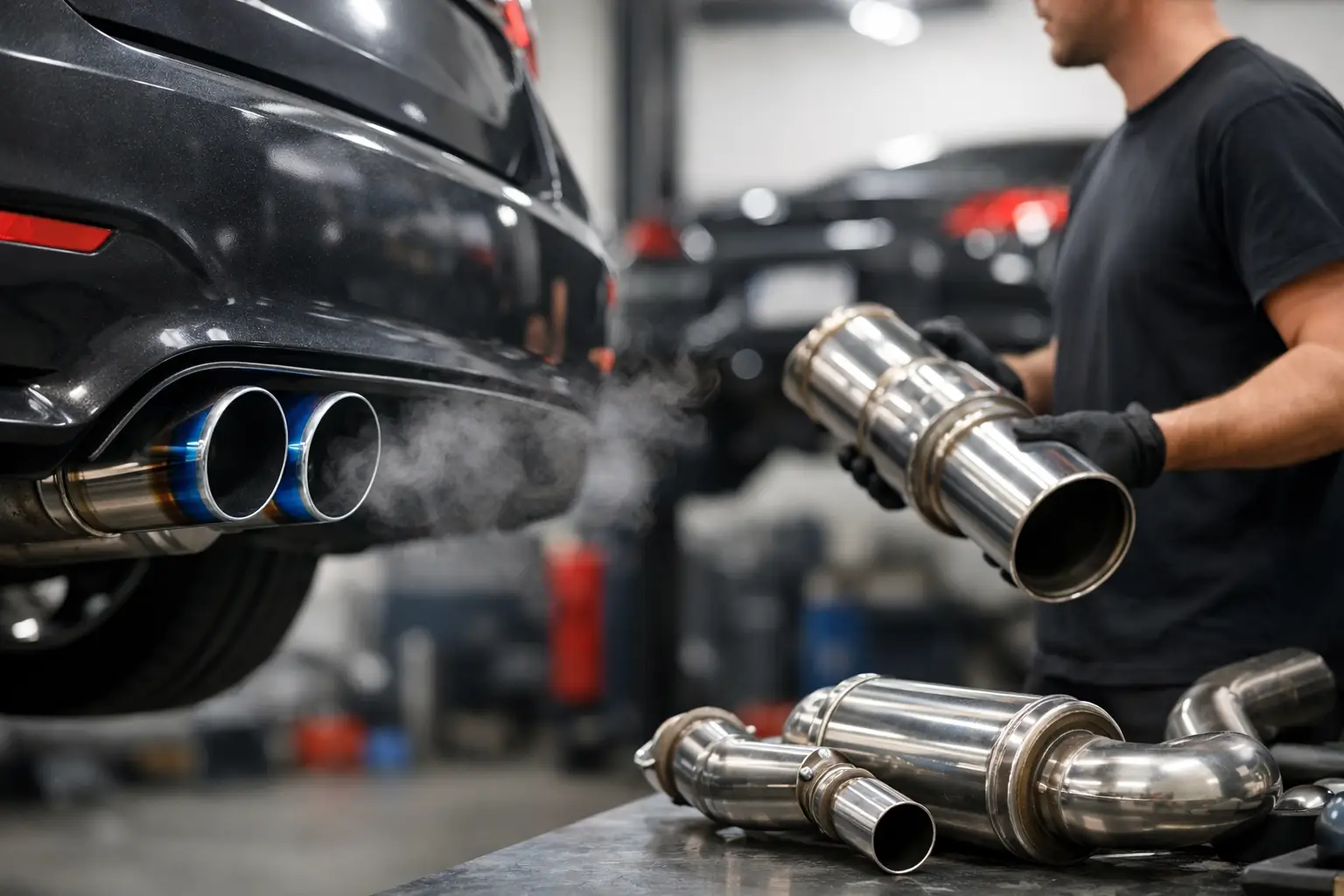
Many car owners immediately ask, “How much horsepower can exhaust modifications increase?” If you expect a standard answer applicable to all models, you’ll likely be disappointed. The truly professional answer is only one: it can increase horsepower, but by how much. This depends on the engine itself, the limitations of the stock exhaust, the parts modified, the pipe diameter design, the catalytic converter efficiency, and whether the intake and ECU calibrations have been completed together.
For performance enthusiasts, exhaust systems are never just about “louder noise.” The exhaust system determines exhaust gas efficiency, directly affecting turbocharger boost, engine high-revving performance, throttle response, and even the light, responsive feel of everyday driving. The question isn’t “whether to modify,” but “how to modify to achieve real horsepower.”
How much horsepower an exhaust modification can increase depends on which section you modify.
The exhaust system isn’t a single part, but an entire airflow channel. Different locations produce completely different effects.
Does the header determine the upper limit?
If we’re talking about which section is closest to a “true performance part,” it’s usually the header, as it’s the only and first exhaust pipe coming out of the engine. Original factory downpipes often prioritise cost, emissions, noise reduction, and packaging space; airflow isn’t the primary goal. Replacing them with a well-designed exhaust manifold or a high-flow downpipe reduces exhaust pulse interference. It improves exhaust flow, especially beneficial for high-revving engines and turbocharged cars in terms of exhaust pressure control.
On naturally aspirated cars, modifying only the downpipe typically increases horsepower by 3 to 8, with some models featuring extremely conservative factory exhausts potentially achieving even higher figures. For turbocharged cars, if the original downpipe and front section are significantly limiting, the increase is usually more direct, with 5 to 15 horsepower not being unusual, but this requires proper matching; simply increasing the size doesn’t guarantee faster performance.
Does the mid-section and tailpipe have a greater impact on airflow characteristics and sound?
Many streetcar enthusiasts modify the mid-section (the exhaust resonator and muffler) and tailpipe first because installation is relatively straightforward, and the visual and auditory feedback is most noticeable. The focus of the mid-section and tailpipe is on reducing drag at higher speeds, optimising pipe bends, and adjusting the muffler structure. It improves high-revving breathability and makes throttle response crisper, but the individual horsepower increase is often perceived as less significant than expected. However, it directly impacts overall emissions.
For most stock naturally aspirated cars, replacing the catback section (mid-section and rear section) typically results in a 2 to 6 horsepower increase if the correct product and specifications are chosen. For some models, the main benefit isn’t peak horsepower, but rather smoother low-, mid-, and high-revving performance and more responsive revving. For turbocharged cars, the performance depends more on the congestion of the stock exhaust. Some small-displacement turbocharged cars, after replacing the high-flow mid-section and rear section, experience faster turbo release, which is more noticeable than the horsepower figures. However, if any part is modified incorrectly, it can become a bottleneck in the entire exhaust system, potentially causing a drop of 1 to 40 horsepower (or even more).
Will a catalytic converter hinder performance?
This is a crucial point often overlooked. Stock catalytic converters typically balance emissions regulations and durability requirements, and can indeed become a bottleneck under high loads. High-flow catalytic converters improve exhaust flow, helping to deliver power without excessively sacrificing street usability.
However, we can’t just look at the output. The catalytic converter’s specifications, honeycomb density, and placement all affect low-end torque, exhaust note probability, and emissions performance. If done correctly, it’s part of a performance upgrade. If done poorly, it will result in noise, exhaust note provocation, and a pungent exhaust odor, without necessarily leading to faster performance.
What is the typical range of real-world horsepower gains?
For a more practical reference, consider this:
For stock naturally aspirated street cars, modifying only the mid-section and rear-section typically adds 2 to 5 horsepower; adding a header and mid-section/rear-section might bring it to 5 to 10 horsepower; with further intake and ECU optimisation, some models can see 8 to 15 horsepower, with some high-revving models showing even more impressive gains.
For stock turbocharged cars, a simple upgrade to the exhaust system typically adds 3 to 8 horsepower, primarily improving responsiveness and high-revving exhaust pressure. Upgrading the header, pre-pipe, and high-flow catalytic converter, along with the ECU tuning, can boost horsepower by 10 to 25, and even more on platforms with conservative stock tuners and significant exhaust limitations.
However, it’s crucial to understand that peak horsepower isn’t the only indicator. What truly makes many exhaust upgrades addictive is the earlier torque delivery, faster revving, and the smooth, responsive acceleration during continuous acceleration. These changes are often more tangible than an impressive peak on a dynamometer.
Why do some people gain only 3 horsepower while others gain 20?
This isn’t about luck; it’s about fundamentally different conditions.
First, consider the vehicle platform. Some stock exhausts are already quite good, limiting aftermarket potential; others are strictly regulated for quietness and compliance, so a high-flow system will naturally provide a significant boost.
Second, consider the engine type. Naturally aspirated engines rely more on overall system optimisation; simply modifying the exhaust alone usually won’t result in a significant performance boost. Turbocharged cars are more sensitive to exhaust pressure, and exhaust optimisation often translates more readily into noticeable power delivery.
Next, consider whether the modifications are systematic. Simply replacing the muffler with a larger diameter one doesn’t equate to a performance upgrade. An excessively large pipe diameter can cause back pressure and flow rate imbalances, potentially leading to a lacklustre low-end performance. A truly effective solution involves logical coordination between the header, front section, mid-section, tail section, catalytic converter, intake system, and ECU.
Finally, consider the testing methods. Engine horsepower, wheel horsepower, different dynos, and varying ambient temperatures all affect the numbers. Experienced enthusiasts don’t just look at promotional images; they assess the consistency between the entire system configuration, testing conditions, and real-world vehicle feedback.
A larger exhaust isn’t always better; choosing the wrong pipe diameter can still negatively impact performance.
Many people don’t like to hear this, but it’s true. Exhaust system design isn’t simply about “bigger pipes for a blocked system.” Airflow velocity, pulse intake, back pressure control, and muffler design all affect engine performance across different RPM ranges.
If a small-displacement naturally aspirated engine has an excessively large exhaust pipe diameter, the exhaust gas velocity decreases at low RPMs, often resulting in a loss of low-end torque. You might hear a louder sound, but the car won’t feel as responsive. Turbocharged cars have a slightly higher tolerance for error, but blindly pursuing an ultra-large pipe diameter can also lead to resonance, changes in the torque plateau, and a decline in everyday driving quality.
A truly mature exhaust upgrade isn’t about maximising the opening size, but rather about a reasonable cross-sectional area, smooth bends, stable welding, and a muffler and valve design that matches the vehicle model. A truly engineered upgrade increases airflow without sacrificing the usable RPM range.
Should you add an ECU to your exhaust modification?
If you’re only replacing the rear section, many models can still be driven normally without an ECU tune, with a slight improvement in power and a more noticeable change in sound. However, if you modify the downpipe, high-flow catalytic converter, or upgrade the entire intake and exhaust system together, ECU tuning is definitely worthwhile.
The reason is straightforward. The stock fuel injection, ignition, and load models are set around the stock exhaust resistance. If the hardware changes and the ECU doesn’t keep up, the full potential won’t be realised. Some cars may even experience issues like oxygen sensor logic and flow changes, causing errors or abnormal air-fuel ratio correction. With proper tuning, the horsepower increase will be more complete, and the throttle response will be more linear.
This is why many people feel that “the sound is there, but the power is mediocre” after installing an exhaust. The problem isn’t necessarily with the components themselves, but rather with the system lacking a closed-loop control.
For real performance gains, how to choose a cost-effective solution?
If your goal is daily usability, easy installation, and a controllable budget, starting with a mid-to-rear exhaust system compatible with your car model is the safest approach. It usually delivers better sound quality, lighter exhaust drag, and more direct driving feedback, and it’s less likely to over-modify the car.
If you want a genuine performance boost, don’t spend all your budget on exhaust tips and appearance. A header, high-flow catalytic converter, smooth mid-section, combined with intake and reprogramming, is a more results-oriented approach. This is especially true for conservative turbo platforms with stock exhausts, where this combination usually offers the best return on investment.
For enthusiasts who want a complete solution tailored to their car model, a complete system is more convenient than piecing together a patchwork solution. The reason is simple – more stable matching, more direct installation, no need for trial and error with pipe diameter and mounting points, and test results are more likely to closely approximate expectations. This is the advantage of brands like Max Racing Exhaust, which have long focused on exhaust and intake system development: they don’t just sell a muffler, but provide a complete, implementable, and verifiable performance path.
Don’t overlook these practical trade-offs
Upgrading your exhaust is worthwhile, but it’s never free.
First is noise and resonance. You might want a more explosive cold start and a thicker high-revving sound, but will the resonance during daily commutes, parking, and long-distance cruising make you regret it? Think it through beforehand. Valve exhausts are more flexible in this regard, balancing street and high-performance modes.
Second is regulations and annual inspections. Different regions have different requirements for catalytic converters, noise, and emissions. Confirming the regulations before buying is much cheaper than installing and then removing.
Third is brand and workmanship. Exhaust systems may look like a bunch of metal pipes, but the welding quality, flange precision, muffler structure, and material thickness all directly affect lifespan, sound, and power performance. The most common problems with cheap parts aren’t a lack of sound, but rather abnormal noises, leaks, resonance, and the extent of any power increase or decrease.
Ultimately, the value of exhaust modification isn’t about instantly increasing horsepower in every car, but about releasing the suppressed breathing efficiency of the stock system. Choosing the right parts, matching the hardware, and ensuring proper ECU coordination will give you more than just higher numbers; you’ll also get faster response, smoother revs, and a more tangible driving experience. A truly worthwhile exhaust modification won’t just let you hear the change, but will make you feel the difference every time you press the accelerator.